ADVERTISEMENT
The British military had always been equipped with the most contemporary timekeepers of their era, from the marine chronometers of Harrison, John Arnold, and other horological pioneers, which gave the Royal Navy the essential ability to reliably determine longitude at sea, to "unbreakable glass" wristwatches advertised by Smiths watches during the First World War. But, when Great Britain declared war on Germany in 1939, few local watch companies could compete with Switzerland’s greater production capabilities, and those still in the business of making components were asked to focus their efforts on building military parts for the Air Force and the Navy.

British commandos on the outskirts of Wesel, Germany, in 1945. Photo Credit: Wikipedia
Switzerland would export large quantities of watches and pocket watches during WWII, to both the Allied Forces and the Germans, but these were civilian market orders which pre-dated the war. The MoD thought these were not suitable to the needs of British soldiers, and decided to place an order for custom-built wristwatches. These needed to be accurate, reliable and durable, which in watchmaking terms meant they had to be regulated to chronometer standards, and also be waterproof and shockproof.
The watches also had to have a black dial, Arabic numerals, luminous hour and minute hands, luminous hour markers, a railroad minute track, a shatterproof crystal, and a stainless-steel case. Powering them would be 15-jewel movements, measuring between 11.75 and 13 lignes.
Twelve companies would fulfill this brief: Buren, Cyma, Eterna, Grana, Jaeger-LeCoultre, Lemania, Longines, IWC, Omega, Record, Timor, and Vertex.
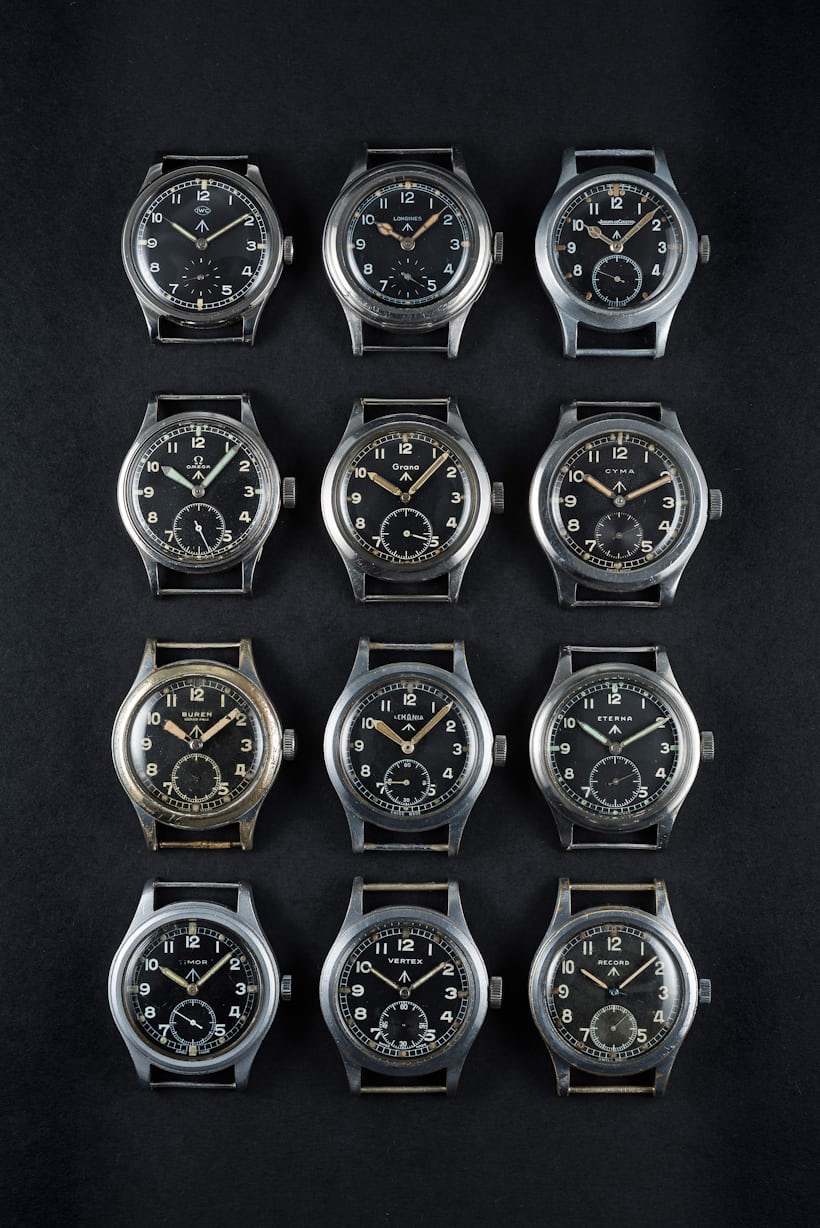
Photo Credit: Watches Of Knightsbridge
Each manufacturer delivered as many watches as their production capabilities would allow. Though official numbers have not been released by the MoD, we believe the largest companies were able to take orders of up to 25,000, while smaller manufacturers produced around 5,000 pieces – only IWC, JLC, and Omega kept a strict record of their order: respectively 6,000, 10,000, and 25,000. Collectively, they would export around 150,000 wristwatches to Britain during the second half of 1945, classified for "General Service" but issued to special units, including radio operators, and artillery staff members.

Case back of the Record, with military and civil serial numbers.

Case back of the Cyma, with military and civil serial numbers.
The Dirty Dozen are easily identifiable by the engraving on the back. The three Ws, which stand for for Watch, Wrist, Waterproof, identify the watches as government property and indicate the type of good in order to distinguish them from weaponry. Other defining features include Broad Arrow heads, on the dial, inner case, and at the back, and two more lines of engravings at the back: a military serial number – a capital letter followed by up to five digits – above a second, standard civil serial number - some watches have the civil one on the inner case. (The use of the Broad Arrow for government goods goes all the way back to Sir Philip Sidney, Joint Master of the Ordnance in 1585, whose family used the Broad Arrow in its coat of arms.)
voir plus replique montre de luxe et replica montre
